CHECK DRIVE BELT FOR CRACKS, FRAYING, WEAR, AND ADJUST ITS TENSION
N802020010000L00ENG
DRIVE BELT CONDITION
Check the whole rounds of the V-belt for cracks, fraying and wear.
ALTERNATOR DRIVE BELT TENSION CHECK <4G6>
CAUTION:
When checking the drive belt tension, make sure that the engine is cold.
Check the drive belt tension in the following procedure.
Standard value:
|
<When the vibration frequency is measured: Recommendation>
 NOTE:
The vibration frequency measuring method is recommended for check and adjustment of the drive belt tension.
CAUTION:
 The temperature of the surface of the belt should be as close as possible to normal temperature.
- Do not let any contaminants such as water or oil get onto the microphone.
- If strong gusts of wind blow against the microphone or if there is loud sources of noise nearby, the values measured by the microphone may not correspond to actual values.
- If the microphone is touching the belt while the measurement is being made, the values measured by the microphone may not correspond to actual values.
- Do not take the measurement while the vehicle's engine is running.
)
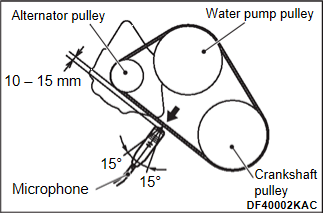
Hold the microphone to the middle of the drive belt between the pulleys (at the place indicated by the arrow), about 10 - 15 mm away from the rear surface of the belt and so that it is perpendicular to the belt (within an angle of ± 15 °).
Gently tap the middle of the belt between the pulleys (the place indicated by the arrow) with your finger as shown in the illustration, and check that the vibration frequency of the belt is within the standard value.
NOTE:To take the measurement repeatedly, fillip the belt again.
<When using the tension gauge>
)
Use a belt tension gauge to check that the belt tension is within the standard value.
<Belt deflection check>
)
Apply approximately 98 N of force to the middle of the drive belt between the pulleys (at the place indicated by the arrow) and check that the amount of deflection is within the standard value.
When the belt tension is adjusted by measuring the belt deflection, adjust it with a tool for vibration frequency measurement or tension measurement afterward.
)
If not within the standard value, adjust the belt tension by the following procedure.
Loosen the nut of the alternator pivot bolt.
Loosen the lock bolt.
Use the adjusting bolt to adjust the belt tension and belt deflection to the standard values.
Tighten the nut of the alternator pivot bolt.
Tightening torque: 22 ± 2 N·m
Tighten the lock bolt.
Tightening torque: 22 ± 2 N·m
Tighten the adjusting bolt.
Tightening torque: 5.0 ± 1.0 N·m
CAUTION:
Check the drive belt tension after turning the crankshaft clockwise one turn or more.
Check the belt tension, and readjust if necessary.
When the belt tension is adjusted by measuring the deflection, adjust it with a tool for vibration frequency measurement or tension measurement afterward.
POWER STEERING OIL PUMP DRIVE BELT TENSION CHECK <4G6>
)
Check the drive belt tension in the following procedure.
Standard value:
|
<When the vibration frequency is measured: Recommendation>
NOTE:The vibration frequency measuring method is recommended for check and adjustment of the drive belt tension.
With your finger tip lightly tap the centre of the drive belt between the pulleys in the location shown by the arrow in the illustration and then measure the belt vibration frequency.
NOTE:Refer to alternator drive belt tension check, for information regarding the vibration frequency measurement method using the tool.
<When using the tension gauge>
Use a belt tension gauge to check that the belt tension is within the standard value at the centre of the drive belt between the pulleys in the location shown by the arrow in the illustration.
<Belt deflection check>
Apply approximately 98 N of force to the middle of the centre of the drive belt between the pulleys in the location shown by the arrow in the illustration and check that the amount of deflection is within the standard value.
When the belt tension is adjusted by measuring the belt deflection, adjust it with a tool for vibration frequency measurement or tension measurement afterward.
POWER STEERING OIL PUMP DRIVE BELT TENSION ADJUSTMENT <4G6>
)
Loosen the power steering oil pump mounting bolts shown in the figure.
Move the power steering oil pump gently and adjust the belt tension and belt deflection to the standard values.
Standard value:
|
Tighten the power steering oil pump mounting bolts.
Tightening torque: 23 ± 3 N·m
CAUTION:
Check the drive belt tension after turning the crankshaft clockwise one turn or more.
A/C COMPRESSOR DRIVE BELT TENSION CHECK <4G6>
NOTE:- An elastic stretch-type belt is used for the A/C compressor drive belt, therefore, the tension adjustment is not necessary.
- Perform the A/C compressor drive belt tension check according to the following procedures.
<When the tension is measured>
CAUTION:
- When measuring the tension, make sure that the engine is cold.
- Measure the tension after turning the crankshaft clockwise one turn or more.
)
Use a belt tension gauge in the middle of the A/C compressor drive belt between the pulleys shown in the figure (at the place indicated by the arrow) to check that the drive belt tension is within the standard value.
Standard value (Reference): 257 - 827 N
If not within the standard value, replace the A/C compressor drive belt.
<When the deflection is measured>
CAUTION:
- When measuring the deflection, make sure that the engine is cold.
- Measure the tension after turning the crankshaft clockwise one turn or more.
)
Apply approximately 100 N of force to the middle of the A/C compressor drive belt between the pulleys (at the place indicated by the arrow) and check that the amount of deflection is within the standard value.
Standard value (Reference): 14.6 mm or less
If not within the standard value, replace the A/C compressor drive belt.
FAN DRIVE BELT TENSION CHECK <4N1>
)
Make sure that the indicator mark is within the area marked with A <Vehicles with Hydraulic Power Steering> or B <Vehicles with Electrical Power Steering> in the illustration.
If the mark is out of the area, replace the drive belt.
NOTE:The drive belt tension adjustment is not necessary as the drive belt auto-tensioner is adopted.
ALTERNATOR DRIVE BELT TENSION CHECK <4N1>
CAUTION:
Check the drive belt tension after turning the crankshaft clockwise one turn or more.
)
Make sure that the indicator mark is within the area marked with A in the illustration.
If the mark is out of the area, replace the drive belt.
NOTE:The drive belt tension adjustment is not necessary as the drive belt auto-tensioner is adopted.