BASE ENGINE
N102460020000400ENG
VALVE MECHANISM
)
The valve mechanism is the high-speed compatible overhead valve (OHV), overhead camshaft (OHC) system the camshaft is driven by the crankshaft sprocket, cogged-type timing belt, and camshaft sprocket.
The camshaft is between the intake and exhaust valves, which are arranged as a V.The valve spring is set between the cylinder head and spring retainer secured by the valve stem by the retainer lock, and is pressed against the valve seat of the cylinder head by spring tension.
When the camshaft rotates, the rocker arm is activated by the cam, using the rocker shaft as a fulcrum, thus opening and closing the valve.The valve stem seal is installed at the upper edge of the valve guide, and functions to prevent the oil from going down in the clearance between the valve guide and the valve stem.
AUTO LASH ADJUSTER
)
These engines have auto lash adjusters that eliminate the need for valve clearance adjustment and reduce noises of the valve system. The auto lash adjuster automatically absorbs change in the valve clearance caused by engine temperature change or wear of parts and adjusts the valve clearance always to zero.
OPERATION OF AUTO LASH ADJUSTER
- AT START OF VALVE LIFT
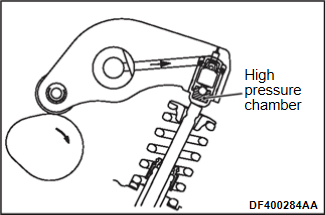 When the cam lifts up the rocker arm, the hydraulic pressure immediately forces the ball in the high pressure chamber against the seat, closing the high pressure chamber.
- DURING VALVE LIFT
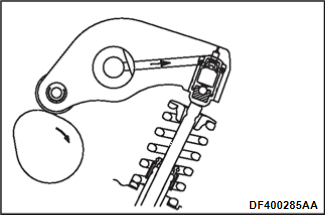 A small amount of oil leaks from the high pressure chamber through a clearance between the body inside and the plunger outside.
- AT END OF VALVE LIFT
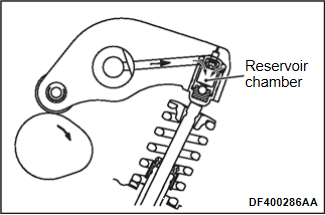 The plunger springs forces the body back to the initial position and oil is supplied to the high pressure chamber to make up for the leaked oil.
)
)
)
TIMING SYSTEM
The timing belt is meshed with the sprockets the crankshaft sprocket becomes the drive sprocket, and thus functions to drive the camshaft and the oil pump.
Timing belt
)
The timing belt is the cogged type, using rubber as its basic material, and it employs a high-strength glass fiber core which dose not expand or contract.The features of the cogged-type belt compared to a chain are no expansion/contraction, low noise level, no necessity for lubrication, light weight, etc.
Auto tensioner
)
A mechanism that uses hydraulic pressure to maintain timing belt tension, which would otherwise change with engine temperature or over time. It makes for reduced noise and enhanced belt durability.
COUNTERBALANCER SHAFT MECHANISM
)
The counterbalancer shaft mechanism functions mainly to eliminate, by the action of the counterbalancer shafts incorporated at both sides of the cylinder block, the vertical vibromotive force of the engine as well as the vibromotive moment in the rolling direction, thus making possible quieter operation of the vehicle.
The two counterbalancer shafts are arranged as shown in the figure below. The right counterbalancer shaft rotates in the same direction as the crankshaft, and the left counterbalancer shaft rotates in the opposite direction. Both of these counterbalancer shafts rotate at a speed twice that of the crankshaft.
Right counterbalancer shaft is driven by timing belt B, and the left counterbalancer shaft is driven by oil pump drive gear.